
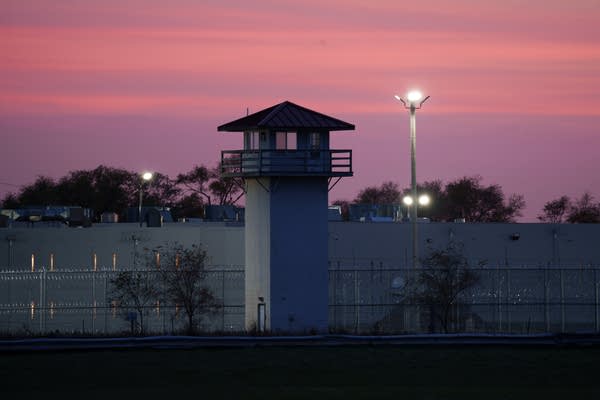
Attorneys and local observers say the first immigration detainees have been transferred to a large new detention center in western Minnesota.
Immigration and Customs Enforcement announced earlier this year that it planned to open the site this fall in Appleton, west of the Twin Cities. The facility, a former private prison, has sat vacant since 2010.
A spokesperson for the American Civil Liberties Union said attorneys there have received “credible and documented reports that at least one individual is currently being held at the facility.”

A group of local advocates said they have also seen more activity around the facility this week, and believe detainees have been brought there. Observers said they spotted vans used to transport detainees drive into the facility early this week.
ICE has not responded to a request for comment from MPR News. The agency’s public list of detention facilities does not include Appleton.
ICE previously said the facility will be fully up and running by mid-2027. It has capacity for 1,600 detainees. Those people could be brought to the center from other county jails around the state, or flown in from other facilities around the country, as is the case at several of ICE’s detention sites.
The center will be operated by CoreCivic, a company that used to own the jail and sold it to the U.S. government earlier this year for $495.6 million. A recent KARE 11 investigation found that was more than six times the price that CoreCivic asked from the state for the property a year earlier.
CoreCivic runs more than 70 detention centers around the country. Several have seen reports of poor living conditions, including the Dilley Immigration Processing Center in Texas.
John Boehler is the policy counsel at ACLU Minnesota. He said he’s concerned about the conditions at the Appleton facility, especially because it was vacant for more than 15 years before reopening. He’s tracked news from other immigration detention facilities around the country that opened quickly after long closures, and said he’s seen reports of health issues and lack of access to basic needs.
He said the federal government isn’t doing enough to make sure conditions are safe.
“What we’ve seen in the past two years is that the executive branch, the federal legislative branch, DHS, ICE, and their private partners have all been working in lockstep, so there hasn’t been true oversight of these facilities,” Boehler said. “The lockstep has been to kind of obscure the conditions of these facilities get them up and running as fast as possible.”
Attorneys and clergy are legally allowed to access detention centers; Boehler said he’s watching to see any news that comes out of Appleton once more people are allowed to go in.
But Boehler said access at the Appleton site could be hard. It’s a three-hour drive from the Twin Cities, and attorneys have struggled to find out where ICE is bringing some of their clients.
And, he said, 1,600 additional immigration detainees in the state could put a strain on resources like mutual aid and attorneys. At the height of Operation Metro Surge, Boehler said, about 800 immigration detainees were being held in county jails around the state.
“Those resources were strained to the breaking point through Metro Surge,” Boehler said. “To take that and multiply it by three or four times, and to put them three hours outside the metro, where there are very few attorneys, let alone specialized immigration attorneys, you’re going to make it quite difficult for these these individuals to get adequate representation.”
CoreCivic says the company expects to make about $75 million in revenue from the Appleton site annually, under its five-year contract with the U.S. government. They’ll receive a fixed monthly payment and a daily payment based on the number of detainees held there.
The news of the new facility has gotten a divided response from Appleton residents. Some have organized protests against it, including a vigil and rally planned for Saturday afternoon.

Brian Wojtalewicz is a local resident who has been protesting the detention center. He said his main concern as the facility opens is for anyone who’s released from there — possibly into the rural roads of Appleton, three hours from the Twin Cities and likely far from their lawyer or good transit options to a major city.
“Are they actually going to throw people out in the street?” he said. “You know, are we going to get any warning?”
He and other organizers have been attempting to plan to help any detainees released there. He said it’s hard to keep eyes on the facility, which is set far back off the main road and mostly surrounded by private farmland.
Wojtalewicz said he also knows people in town who are glad to see the site opening. Appleton’s economy used to rely heavily on the prison there; some are hoping that the job opportunities and staff at the facility will give the town a boost.
“Anyone who’s lived in little town America realizes how much little towns are on their knees for jobs, for higher incomes,” Wojtalewicz said.
And the jobs at the detention center, he said, pay higher than other jobs around the area.
Wojtalewicz said he and other opponents of the site are keeping eyes on it this week. Attorneys are waiting to see if other clients are transported to the site — and to see if they’re eventually allowed inside to see the conditions there.