
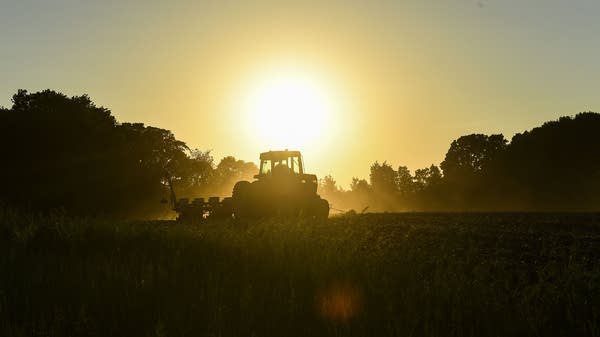
Robert Roelofs, a livestock and crop farmer from southern Minnesota’s Garden City, isn’t particularly excited about this year’s midterm elections.
“You almost feel like sometimes you’re going to the polls and voting for the lesser of two evils,” Roelofs said.
These past two years have been tough on Roelofs, despite the Trump administration’s promises to help farmers. The war in Iran, for example, has driven up his diesel costs.
“Also, all of these trade disruptions, none of that’s getting solved,” said Roelofs. “We keep saying that, ‘Oh, it’ll be great for the farmers.’ Well, I ain’t seen it yet, and I’ve been a Republican for a long time, and we ain’t seen it.”

He’s disappointed with the Trump administration’s performance. And while he’d like to see change, he feels Democrats push regulations that make life harder for farmers.
“Man, I’ll tell you that the Democrats in the state of Minnesota are very frustrating to the rural farmer, no question about it,” said Roelofs.
No side appeals to him, but regardless, with midterm elections around the corner, he has to choose who to vote for.
“This is probably one of the more challenging elections I voted in to be honest with you, as a rural Minnesota person,” he said.
The rock-and-a-hard-place vote
Amy Frederiksen, who specializes in media relations and has been a Republican political strategist, said farmers are caught between a rock and a hard place. She imagined what they might be thinking
“Republicans, we thought you were with us, and we feel like you’ve been now dismissing us for a couple of years and not listening to what we’re concerned about,” said Frederiksen. “But Democrats, you haven’t been with us, and now is that who I’m supposed to choose?”
Rural Minnesota once tended to vote blue, Frederiksen said. But she said President Donald Trump has accelerated a shift in greater Minnesota favoring Republicans.

“Democrats had really stopped listening and had not been listening to [farmers] for a very long time,” said Frederiksen. “It was in particular Donald Trump, but also just Republicans in general, that said, ‘Hey, we see you, and we share your concerns,’ and that was a big part of turning the tide.”
In his 2024 campaign for office, Trump said he’d tackle over-regulation, trade negotiations and bring down the cost of fuel.
The campaign push worked, with many farming counties nationwide voting for President Trump.
Since then, a raft of tariffs on friends and foes alike has increased operating costs and shrunk markets. A war with Iran also sent diesel prices soaring as the conflict between Russia and Ukraine continues, exacerbating the problem.
But Frederiksen said that while farmers may feel disappointed by Trump’s policies, that doesn’t necessarily mean they’ll vote for the Democrats, who, she said, are “singing an affordability song right now because there’s an election.”
“But they haven’t done anything to recapture or re-recognize greater Minnesota,” said Frederiksen. “And the ag community is not just going to so readily hand over the reins to the Democratic Party, either.”

Decisions, decisions
Jason Keck, a livestock and crop farmer from Steele County, said that even though the Trump administration’s tariffs have brought financial pain, he believes they’ll put U.S. commerce in a better spot in the long run.
“That was one of Trump’s plans: how do we bring America back to the forefront on trade and getting a good deal,” said Keck.
Still, Keck added that the administration’s tariff policies increased volatility, making life harder for farmers. He also worries about the long-term impacts of trade disputes.
“The trade war has kind of reinforced some of South America’s position as a seller to China, and that might have some long-term ramifications,” said Keck. “But at the end of the day, we have the best product in the country in the world, and so they’re going to keep coming. They’re going to keep buying from us.”
But despite those concerns, Keck said the administration has made some positive developments, such as making changes to crop insurance programs. He also looks at the administration’s investment in domestic fertilizer manufacturing as a good sign.
Ultimately, he says he’ll vote for Republican candidate Michele Tafoya for U.S. Senate. He was among Minnesota Farm Bureau members who interviewed candidates ahead of potential endorsements and said he was impressed by her awareness of agricultural issues. The Minnesota Farm Bureau ultimately endorsed her.

Keck added that her opponent, Democratic U.S. Senate nominee Peggy Flanagan, simply carried too much baggage from her time as the state’s Lieutenant Governor during recent fraud scandals rocking Minnesota.
The governor’s race was a tougher choice for him. Keck said Republican governor nominee Lisa Demuth, Minnesota’s House speaker, has more state-level experience. But he said that DFL governor nominee Amy Klobuchar, a current U.S. senator has a strong reputation among farmers.
But in the end, Keck said he feels Demuth’s local ties and experience outweigh Klobuchar’s. He’s also more aligned with Demuth’s social issues.
“As a state, we’ve put too much money in social programs,” Keck said. “Obviously, with what’s come to light in recent years, I think we should be more fiscally responsible.”

Andy Maier, a crop farmer from Wilkin County, wouldn’t say who he’d vote for in this election. He likes how the Trump administration has pushed for deregulating different aspects of farming. However, it’s not enough to offset the financial pain from the administration’s trade policies.
“We got into these wars, and all of a sudden, our diesel prices double what they were a year ago, and that was because of a policy decision made in Washington,” said Maier. “How are we supposed to manage around that?”
He said choosing a gubernatorial candidate in Minnesota will be particularly tough.
“Senator Klobuchar is a very powerful farm advocate in Washington,” said Maier. “So, if we take her and keep her at home in St. Paul, that takes a big advocate for Minnesota farmers out of Washington, D.C.”

Robert Roelofs, the producer from Garden City, said he’s still mulling over who he’ll support. He says he’ll likely vote Republican on state-level issues because he feels they have his best interests in mind.
As for the U.S. Senate seat, despite his frustrations with the GOP, he’ll likely vote for them too, partly because he’s expecting that a blue wave could embolden more Republicans to defy President Trump more often.
“Let’s say the Democrats win the House or the Senate on the national level, you’re going to see a lot of Republican resistance to the president come out,” said Roelofs.